



Can I Get More Than One Certificate in Techverve?

5 minutes read
Have you completed your first course in Techverve, proudly received your certificate, and then immediately thought, “Can I earn another one?” Probably you have.
Many learners have this exact question when they start get started. In today’s fast-moving tech world, having just one certificate is good, but building a collection of them can set you apart.
Imagine walking into a job interview or pitching to a client with multiple verified certificates backing your skills. That is real proof of growth. Now to answer the question:
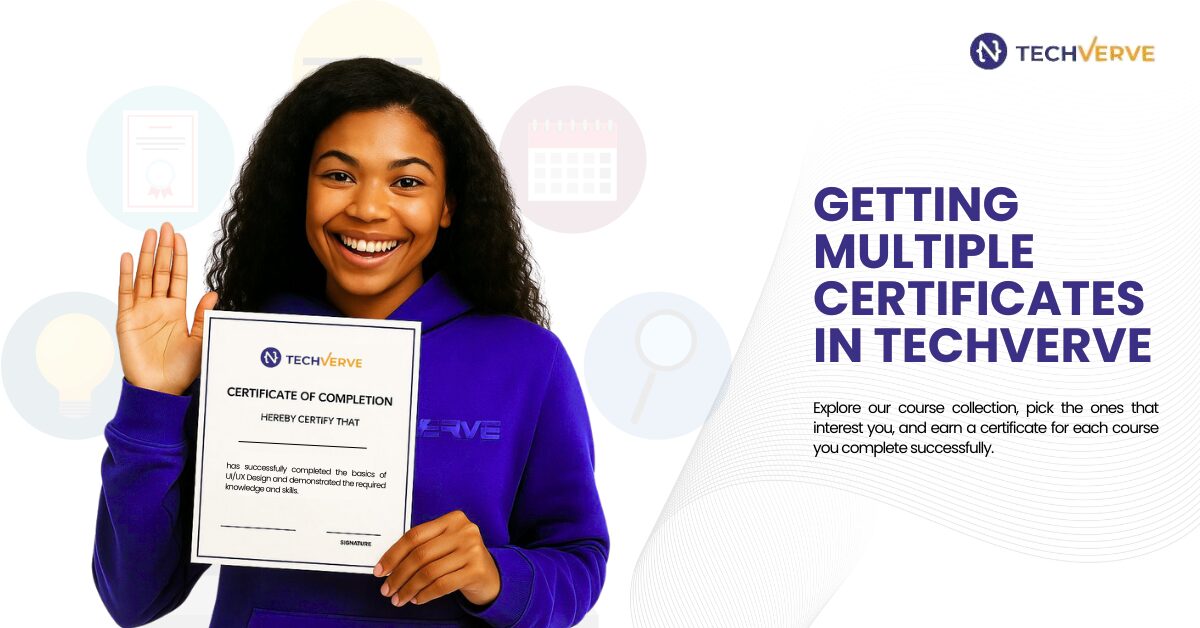
Yes, you can get more than one certificate in Techverve. Every course you complete comes with its own certificate. No hidden tricks or complicated rules to hold you back. Provided you continue learning, you can continue to add certificates to your name.
However, there are some conditions to keep in mind. You must complete each course’s lessons and requirements.
Some courses may have assignments, quizzes, or final projects you need to pass before receiving your certificate. Others may only require you to complete all modules.
Whichever way, your certificate is sure for you when you successfully pass the course requirements.
How Does Techverve’s Certificate System Work?
Each Techverve course is its own journey. When you start one, you are stepping into a structured learning path. Once you complete it, you get a Hero certificate.
This is your first milestone, proof that you’ve mastered the basics and are ready for more. From there, you can progress to the intermediate level of that same course.
Completing this stage earns you the Commando Certificate. It shows you’ve gone beyond the fundamentals and are starting to develop real, practical expertise.
If you want to go even deeper, Techverve allows you to advance to the Titan Certificate, which is awarded at the advanced level. This is the highest recognition within any course, a sign that you have not only learned but also mastered the field.
Additionally, you can begin with a course.For example, let’s say Introduction to Web Development. After completing it, you’ll earn your first certificate and might feel motivated to explore more.
Next, you can enroll in another course, such as UI/UX Basics or Frontend Development. Each completed course earns you a new, independent certificate.
There is no waiting period between courses. You are free to start your next one immediately or take a break before returning. This flexibility is perfect for busy learners or anyone balancing studies with daily life.
Are There Benefits of Getting Multiple Certificates?
Yes, there are! Having one certificate shows you made an effort, but having several of them means you are serious about growth.
Think of certificates as stepping stones in your tech journey. Each one moves you closer to your goal, whether it is getting your first job, landing a promotion, or starting your freelance career.
Employers, recruiters, and even freelance clients look at multiple certificates as proof of consistent learning and updated knowledge. In tech, where tools and frameworks change fast, this is a major advantage.
Take Sarah, for instance, a recent graduate aiming to break into the tech industry. She began with a Basic Digital Skills certificate to build her foundation, then completed Frontend Development for Beginners, and later added Advanced JavaScript Techniques to her portfolio.
Now, when applying for a junior developer role, she doesn’t just talk about her interest in coding; she presents certificates that clearly show her learning journey and commitment.
Just like Sarah, you too can build a strong learning path, and it all begins with taking the first step.
How to Start Your Journey Toward Multiple Certificates
The best part is, you do not need to overthink it. Start small; start where you are.
- Pick your first course wisely. If you are new to tech, start with something foundational like digital skills, web basics, or intro to design.
- Focus on completing it fully. Rushing through without absorbing the lessons will not help you later.
- Download and save your certificate. Keep a folder, digital or printed, where you store them all.
- Move on to the next course. Build on what you have learned. If your first was about web design, your next could be about user experience or basic coding.
- Showcase your achievements. Post your certificates on LinkedIn, include them in your CV, or share them in your portfolio.
The beauty of Techverve is that you can learn at your own pace. Whether you want to stack two certificates in a month or spread them across the year, the choice is yours.
Is It Better to Specialize or Diversify?
Some learners wonder, Should I focus on one course deeply or collect many? The truth is, it depends on your goals. If you want to specialize in one field, multiple certificates within that area can make you stand out as an expert.
If you want to explore different fields such as design, development, and marketing, earning various certificates can make you versatile.
The real value comes when you combine these certificates with practical application. Do not just collect them for show.
Use your skills in projects, internships, or freelance work. This way, your certificates become proof of both knowledge and experience.
Conclusion
To conclude, earning multiple certificates in Techverve is not just possible; it is encouraged. Each certificate you collect is a building block toward your bigger career vision.
Start with one course, finish it, and move to the next when you are ready. Before you know it, you will have a stack of achievements that speak louder than words. They show discipline, growth, and a hunger to stay relevant in the ever-changing tech world.
Want to make your learning journey smoother and gain a better understanding of Techverve certificates? Read our article “How to Successfully Get a Certificate on Techverve and Boost Your Career.”




Leave a Comment